


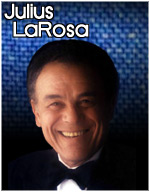
By the age of twenty-two, he was a regular on the Arthur Godfrey Television Show. With great success he lasted twenty three months until the headlines announced "Godfrey Fires Protégé". Julius went on to collect stage credits in Neil Simon's first Broadway success, Come Blow Your Horn. He has headlined musical shows throughout North America.
LaRosa is truly an entertainer with experience, and to quote the New York Times "…his singing is very direct and unpretentious - he can wrap his voice tenaciously around a melody line and bring out the best in it. He is certainly an equal partner to the song lyric." Julius continues to give life to many of the popular songs from the 40's and 50's. His hit recording of "Eh Cumpari" has become an Italian Tradition throughout North America.
Click the play button below to watch video:
Julie's Story
"Brooklyn - that's where it all started. We didn't have to contend with rock and roll back then, and when it came, I still didn't contend with it."
Julius LaRosa is a Brooklyn boy, and don't forget it. He was born on January 2, 1930, and grew up with his sister in a world that was vastly different from today. LaRosa remembers even in the relatively tough Brooklyn world, you didn't worry about making sure the door was closed. You didn't worry about vandalism, much less the more violent crimes so prevalent today. He grew up to be a congenial, straigh-speaking man with a keen sense of music and a good sense of humor.
"I had them all. Sinatra was able to turn a 32-bar song into a three-act play… I like all kinds of music. I grew up with Tommy Dorsey, Glenn Miller. That was music. It has a certain gentleness, you had a rhythmic response to it. Rock and roll seemed very unmusical. But there's always been room for the traditional singer."
For Julius LaRosa, his career is singing, even though he's proven to be a successful disc jockey and actor. He no longer lives in Brooklyn, having moved years ago to Westchester County, New York. He and his wife raised a son and daughter there. Neither are professional musicians, although LaRosa says his son plays guitar and has a good ear, great musical instincts, sense of rhythm. LaRosa remembers first moving to Westchester.
"Being born and raised in Brooklyn, I was always walking on concrete. When I walked on grass, it was like I moved to the country, which is what I wanted to do. Now with all the building (in the area_, I call it 'Times Square North.'"
LaRosa began his singing career during a melodic time. The career that would later include the finest rooms in the country - Carnegie Hall, Philadelphia's Academy of Music, cabarets like Rainbow and Stars, and jazz rooms like Michael's Pub, as well as summer fairs, school auditoriums and ballparks - that career began in a new medium, television. LaRosa had no idea what was coming.
LaRosa had finished high school and joined the Navy. In the last nine months he sang with the United States Navy Band in Washington D.C. and was "discovered" by Arthur Godfrey, a leading television entertainer of the day, who said, "Young man, when you get out, come see me. You've got a job."
"I didn't know that was just 'show business.' He said I had a job, so when I got out of the Navy I went up to see him. I was discharged on a Friday and on Monday I went up. And a week later I was on the show. That's exactly how the whole thing started."
November 19, 1951 to October 19, 1953 - 23 months to the day, Julius LaRosa was a member of the immensely popular CBS TV series Arthur Godfrey and his Friends. It was a variety hour centered around Godfrey and his "friends" including Frank Parker, Tony Marvin, Julius LaRosa, Haleloke, Marion Marlowe, the McGuire Sisters and bandleader Archie Bleyer. LaRosa's early audiences thought of him as shy.
"I wasn't ever shy. I was just scared to death. I had never been a professional singer, except when I was in the Navy. That was my first professional singing. Six months later I'm on the radio, I'm on televsision. Don't know what the hell I'm doing. Just scared to death. But that fear just manifested itself as shyness."
LaRosa worked during the week on Godfrey's various shows and later worked other engagements on the weekends. He also began taking some voice lessons with Carlo Menotti, disregarding dire warnings by some that lessons would ruin the natural quality of his voice. The lessons came about when LaRosa heard a young singer on Arthur Godfrey Talent Scouts show with a pleasing natural voice and he asked who the singer's teacher was. When he found out, he started regular voice lessons to clear up problems or work out approaches to a particular song.
LaRosa also started recording. In fact, Godfrey's orchestra leader, Archie Bleyer, formed Cadence Records in late 1952, primarily to record LaRosa. Bleyer's orchestra would back him on record as well as on television performances. Julius LaRosa's first recording, and Cadence Records first single release, "Anywhere I Wander." It shot immediately into the national top-30. LaRosa followed this with "My Lady Loves To Dance," which was a moderate success.
The third release was a golden charm. In 1953, he recorded "Eh, Cumpari." This novelty song was a run-away hit, reaching number two. Julius LaRosa won an award for best new male vocalist for 1953. He had done well for Cadence Records. In fact, he was their only singer that first year. The label of the 45 rpm label had a drawing of his likeness across the top.
And then one night in fall 1953, after Julius LaRosa finished singing, "Manhattan," on Arthur Godfrey and his Friends, Godfrey fired him on the air. The public was in an uproar.
"Thank God for the press's awareness and the public's awareness! They knew that the big guy should never hurt the little guy. And Arthur Godfrey was the big guy, trying to hurt the kid, and that's why they turned on him. And the public turned on him really bad.
"The man literally is the father of my career and I'll always be grateful to him. But it turned out he wasn't a very nice man."
LaRosa thanked Godfrey for giving him his great break and left the show.
He learned Godfrey could not overlook the fact that LaRosa had hired a manager after his first hit records. No one of Godfrey's "friends" could have an outside manager. In addition, LaRosa (like the other men on the show) had refused to go to dance classes ordered by Godfrey. Perhaps coincidentally, Godfrey reputedly had a soft spot for Dorothy McGuire, who was involved with LaRosa. However, the stated reason for the firing was, said Godfrey "a lack of humility." For years, LaRosa wondered what that meant, and today he believes:
"Fundamentally, humility is not a quality that exists in people. It is something only between a person and his God. What people consider 'humble' is actually good manners. Good manners is the bottom line."
Arthur Godfrey, a man whose public image was down-to-earth, plain-speaking Mr. Nice Guy, was actually tyrannical and judgemental. "And he was a guy who couldn't afford to be judged!"
Unfortunately for Godfrey, this happened just before "Eh Cumpari" went on to be a top pop single in 1953, followed by "Domani," another hit song for LaRosa and Cadence Records. Arthur Godfrey's shows, and his career, went into a decline and never recovered.
LaRosa moved to RCA Records, hoping to get a bit of the rock audience, but basically, after the split with Godfrey, LaRosa says:
"I went out and learned my job. And it took 15 years to really get comfortable doing it… I learned my job in public - how to walk onstage, how to control an audience, what materials to use, what taste was."
LaRosa has a full and ready laugh and a generous nature. He's a performer who gets along easily with people in and out of the business, even when circumstances become difficult. He's learned from the past.
"No matter what the circumstances, if you work for a man, you're working in his place, he's your 'boss.' You do what your boss asks you to do. If it's totally against what you want to do, you don't work for the man. It's that simple. It's a business…
"I've been using this same act for ten years, with some changes, and it's still fresh. It still works… Nobody knows better than I, what song is good for me…
"Big or small, I like the audience right in front of me. Even when I work in nightclubs, I keep the lights on, because I want to see your face too. That's the way I work at my best. All I have to do is make one eye contact and I'm in contact with everybody else. I don't assume another character, I'm always me, Julius LaRosa. Here it is."
Julie and Music
"I try to tell the story of the song in a way that no one has heard before."
Through his love for popular music, Julius LaRosa has become well-versed in musical history, and he is outspoken about his opinions. He has definite likes and dislikes, and he enjoys sharing his ideas.
Like most singers, he is first attracted to the lyrics and as a story-teller, he prefers ballads:
"It's more comfortable to tell the story slowly than fast. There isn't much story-telling in a rhythm section… I try to tell the story of the song in a way that no one has heard before. I try to sing as if I were just talking casually with someone."
On Sondheim:
"Stephen Sondhem is a genius, but very intolerant of other people. I'm an interpretive person, and don't deprive me of taking those lovely words he wrote and giving them my experience in terms of the phrasing of it. This is popular music and for (Sondheim) to assume what I think is the pomposity, of rejecting interpretations of his words…
"I recorded ('Send in the Clowns'), and I heard he was very scornful of it. And he's entitled to be scornful of it, but he's not entitled to diminish the attmempt. I love speaking my piece about it."
He adds "(Sondheim) wrote one of the loveliest songs, 'Maria,' - 'Say it ould and there's music playing, 'Say it soft and it's almost like praying.' My God! That's heavenly…
"Then he gets very artsy-fartsy. It's like he's challenging the listener to find his meaning."
On Lorenz Hart:
LaRosa relates what he admits is probably an apocryphal story about Lorenz Hart, the master rhymester. Hart was sitting in a restaurant when a stranger came up and challenged him to rhyme "Coolidge." Hart thought a minute and begain tapping to a beat:
"Coolidge, he deserves a eulogy."
On Sammy Cahn:
One of LaRosa's early favourite songs was "Bei Mir Bist du Schon," and years later, one of the treasured aspects of being in show business was getting to know the song's lyricist, Sammy Cahn, and becoming his friend and occasional lunch companion. He wrote a tribute for Sheet Music Magazine on the occasion of one of Cahn's birthdays. The title told all - "Picking My Favourite Sammy Cahn Song - or- Sam, You Made the List Too Long!"
On Jonny Mercer:
"He was the best of them all. He could write in any style - write happy, write sad, everything… That's the fellow who wrote 'palace,' 'chalice,' 'aurora borealis'."
In the past few years, LaRosa joined other performers contributing to "Johnny Mercer tributes" found in the Johnny Mercer Educational Archives.
Oh Harry Warren:
"He had a reason to be bitter, because he never achieved the notoriety as the other people did, and he was as good as the other people. It wasn't all Tin Pan Alley. Anyone with a sense of melody has to be a Puccini fan, and he was a big Puccini fan."
LaRosa enjoys reciting, and even more singing, the lyrics of songs he love. "You know the song, 'More'? Lovely melody. I only sang it once because when I got to the end, I felt like I was lying. It's a fake rhyme!"
(The song ends: "I know I've never loved before, but my heart is very sure, no one else can love you more.")
About a year ago, LaRosa received a request from someone who was putting together a collection of celebrities' favourite certain quotes, and the reason the particular selection was submitted by LaRosa:
'You make me smile with my heart.' (from My Funny Valentine)
"For me, it's a very basic thing, nothing psychological about it. It's simply if a person makes you smile with your heart, that's your life. It's one of the loveliest thoughts of any song I ever sung."
n Elizabeth Ahlfors
Aside from singing:
Radio
For almost a decade, Julius LaRosa was a disc jockey on WNEW, 1130AM. In April 1999, LaRosa was back, this time on WNJR, 1430, hosting "The Make-Believe Ballroom" daily from 9am to 1pm. That show has been cancelled.
Theater
LaRosa has performed in an eclectic mix of plays including:
- Come Blow Your Horn
- Six Rooms River View
- Kiss Me Kate
- Guys and Dolls
- West Side Story
- Stalag 17
- In 1980, Julius LaRosa was nominated for a Best Supporting Actor Daytime Emmy for his work as Reynaldo on Another World.
- Singing Johnny Mercer -
June 1995 - the New York JVC Jazz Festival, with Margaret Whiting, Ben Tucker, Emma Kelly, The Lady Chablis and others in the concert version of the prize-winning book, Midnight in the Garden of Good and Evil. The concert is based on the songs of Johnny Mercer. LaRosa later travelled with the show.
- He was also featured in "Hooray for Johnny" with Margaret Whiting
- LaRosa is a frequent guest on "Jim Lowe and Friends" Fridays at 3pm on WRTN - 93.5FM, and 7pm on WVOX - 1460AM
"Julius LaRosa is one of the finest singers in that generation influenced by Frank Sinatra,"
-- Gene Lees, Jazzletter
Inquire about Julius LaRosa at our Contact Us page.
Julius LaRosa Promo Video
Visible in middle column of this page.